RAG in Artificial Intelligence: How Retrieval-Augmented Generation Makes AI Smarter and More Reliable
RAG connects AI language models with external knowledge sources to generate more accurate and context-aware responses. Learn how it works, its business applications, key components, and implementation challenges.

Introduction
Artificial Intelligence has made remarkable progress in recent years, particularly in the development of Large Language Models (LLMs). Tools powered by models such as GPT can understand natural language, generate content, summarize documents, and assist with complex tasks. However, despite these capabilities, AI models still face an important challenge: they do not always have access to accurate, up-to-date, or domain-specific information.
A language model may provide an outdated answer, misunderstand a technical question, or generate information that sounds convincing but is factually incorrect. This phenomenon is commonly known as AI hallucination.
Retrieval-Augmented Generation (RAG) offers a practical way to address these limitations. By connecting large language models to external knowledge sources, RAG allows AI systems to retrieve relevant information before generating responses. Instead of depending entirely on previously learned information, the model can reference specific documents, databases, and other data sources to produce more relevant and context-aware answers.
Today, RAG is becoming an important technology for enterprise AI, intelligent customer support, knowledge management, research automation, and many other applications.
But how exactly does it work, and why are businesses increasingly adopting it? Let's explore.
1. What Is Retrieval-Augmented Generation (RAG)?
Retrieval-Augmented Generation, commonly abbreviated as RAG, is an AI framework that combines information retrieval with natural language generation.
In simple terms, RAG enables an AI model to search for relevant external information before answering a user's question.
A traditional Large Language Model generates responses primarily based on patterns and information learned during training. Although these models possess extensive general knowledge, their internal knowledge may not include the latest developments, private company documents, or specialized information.
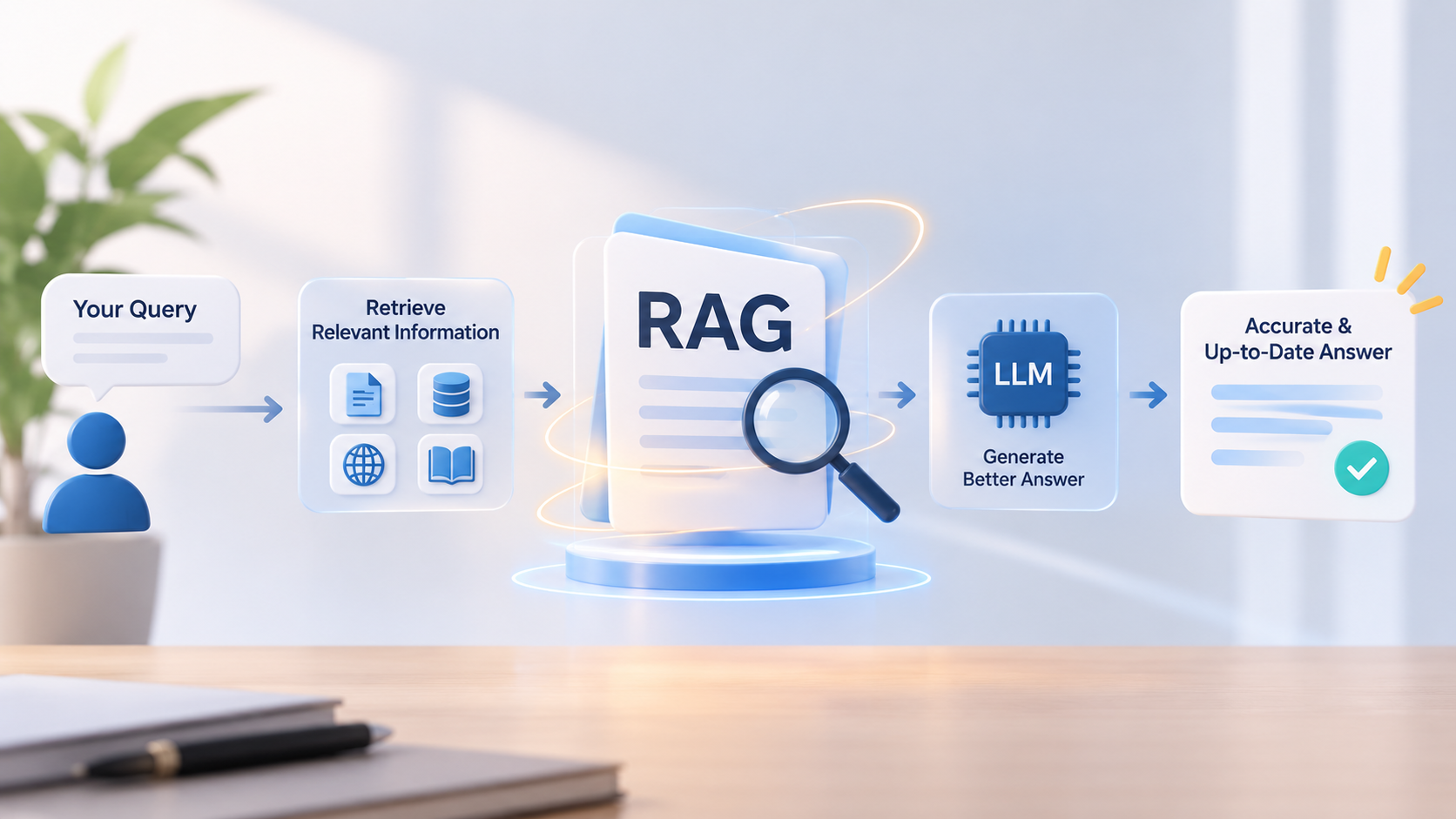
RAG introduces an additional retrieval process. When a user submits a question, the system searches a connected knowledge base, identifies relevant information, and provides that information to the language model as additional context.
The model then uses the retrieved content to generate a response.
For example, imagine an employee asking an internal AI assistant:
"What is our company's refund policy for international customers?"
A conventional AI model might generate a general answer based on common business practices. However, a RAG-powered assistant can search the company's actual policy documents and use the relevant sections to answer the question.
This makes the response more closely aligned with the organization's internal rules.
Importantly, RAG does not require developers to retrain the entire language model whenever new information becomes available. Instead, they can update the external knowledge base and allow the retrieval system to access the latest documents.
2. How Does RAG Work? Understanding the Complete Process
A typical RAG system operates through several interconnected stages. Although implementations vary depending on the application, the overall process generally includes data preparation, information retrieval, context augmentation, and response generation.
Step 1: Collecting and Preparing Data
Before an AI system can retrieve information, it needs access to a knowledge source.
This information may come from different places, including:
- PDF files, Word documents, and spreadsheets.
- Company websites and online documentation.
- Internal databases and knowledge management platforms.
- Product catalogs and technical manuals.
- Customer service records and frequently asked questions.
- Research papers and other specialized resources.
Raw information usually needs to be cleaned and organized before being added to the knowledge base.
One common technique is called text chunking. It involves dividing large documents into smaller sections so that the retrieval system can identify relevant information more efficiently.
For example, a 100-page technical manual can be divided into multiple smaller text segments. Each segment can then be processed and indexed independently.
The quality of this preparation stage has a significant impact on the performance of the entire RAG system.
Step 2: Converting Information into Embeddings
After documents are prepared, an embedding model converts text into numerical representations called vector embeddings.
These vectors capture semantic characteristics of the original text, allowing a system to identify relationships between different pieces of information.
For instance, a user might search for:
"How can I change my account password?"
The knowledge base may contain a document titled "Account Security and Credential Management."
Although the wording is different, both expressions relate to the same concept. Semantic search can help identify this relationship even when the exact keywords do not match.
The resulting vectors are stored in a vector database, where they can be searched efficiently when new questions arrive.
Step 3: Retrieving Relevant Information
When a user submits a question, the retrieval component processes the query and searches the knowledge base for relevant content.
Depending on the implementation, the system may use:
- Semantic search: Finds information based on meaning rather than exact keyword matches.
- Keyword search: Identifies documents containing specific terms or phrases.
- Hybrid search: Combines semantic and keyword-based retrieval.
- Metadata filtering: Narrows results according to attributes such as date, document type, department, or access permissions.
Some advanced systems also use reranking models to evaluate the initial search results and move the most relevant passages to the top.
This step is important because retrieving irrelevant or incomplete information can negatively affect the final answer.
Step 4: Augmenting the AI Prompt
Once relevant information has been retrieved, the system combines the original user question with the selected documents or text segments.
This creates an enriched prompt containing additional context.
For example:
User question: "What payment methods do you support?"
Retrieved information: "The platform currently supports Visa, Mastercard, and selected digital payment methods."
The system sends both pieces of information to the language model.
Rather than answering entirely from its general knowledge, the model now has access to specific information related to the user's question.
Step 5: Generating the Final Response
In the final stage, the language model analyzes the augmented prompt and generates a natural-language response.
Depending on the system's design, the answer may also include references to the original documents, page numbers, or source links.
This allows users to understand where the information came from and verify important details when necessary.
Overall, RAG creates a connection between external knowledge and AI-generated responses, making it possible to build applications that are both conversational and information-driven.
3. The Core Components of a RAG Architecture
A functional RAG system involves several technical components working together. Each component has a specific responsibility, and the quality of their integration determines the overall effectiveness of the system.
Component | Primary Function |
|---|---|
Data Sources | Provide documents and information for the knowledge base. |
Document Processor | Extracts, cleans, and organizes raw content. |
Embedding Model | Converts text into numerical vector representations. |
Vector Database | Stores embeddings and supports similarity searches. |
Retriever | Finds relevant information based on user queries. |
Reranker | Improves search relevance by reordering retrieved results. |
Large Language Model | Generates responses using the retrieved context. |
Orchestration Framework | Coordinates communication between system components. |
Several technologies are commonly used to build these systems.
For example, Pinecone, Weaviate, and Chroma provide vector database capabilities, while frameworks such as LangChain and LlamaIndex help developers connect different parts of a RAG pipeline.
The choice of technology depends on factors such as data volume, retrieval speed, infrastructure requirements, security policies, and application complexity.
There is no single architecture that works best for every project.
4. Why Are Businesses Adopting RAG?
RAG is attracting attention because it addresses several practical problems associated with deploying AI in real business environments.
Here are some of its most important advantages.
Access to Updated Information
One major limitation of traditional language models is that their internal knowledge does not automatically reflect every new development.
RAG helps overcome this issue by connecting AI applications to external information sources.
When a company updates its product documentation, pricing information, or internal policies, the relevant knowledge base can be updated without necessarily retraining the underlying model.
This is particularly valuable for industries where information changes frequently.
Reduced AI Hallucinations
AI hallucinations can create serious problems when applications are used for business decisions or customer communication.
By providing relevant reference materials before generating a response, RAG helps reduce the likelihood that a model will rely entirely on unsupported assumptions.
However, it is important to understand that RAG does not completely eliminate hallucinations. A model may still misunderstand retrieved documents or generate conclusions that are not supported by the available information.
For this reason, source validation, response evaluation, and appropriate safeguards remain essential.
More Relevant and Context-Aware Responses
Generic AI models are designed to handle a wide range of topics. However, businesses often need systems that understand their own products, services, terminology, and internal processes.
RAG makes this possible by connecting language models to specialized knowledge bases.
For example, an e-commerce company can build an AI assistant that references its product specifications, delivery policies, and return procedures.
The result is a more useful experience for both employees and customers.
Lower Knowledge Maintenance Costs
Training or fine-tuning an AI model can require considerable technical resources.
RAG provides another approach: maintain the external knowledge base separately from the language model.
When information changes, developers can update the relevant documents and refresh the retrieval index.
This can simplify ongoing maintenance, particularly for organizations managing large collections of frequently updated information.
Better Use of Existing Business Data
Many organizations already possess valuable information stored across different systems.
However, employees may struggle to locate the right document or identify the information they need.
A RAG-powered assistant can make these resources easier to access through natural-language questions.
Instead of manually searching through folders, databases, and internal documentation, users can ask direct questions and receive answers based on relevant company information.
5. Practical Applications of RAG Across Different Industries
RAG is not limited to research laboratories or advanced AI development projects. It has practical applications across a wide range of industries.
Customer Support and Intelligent Chatbots
Customer service is one of the most straightforward applications of RAG.
Businesses can connect AI chatbots to product documentation, troubleshooting guides, shipping information, and customer support policies.
When customers ask questions, the chatbot retrieves relevant information and generates responses based on the company's actual resources.
This can help improve response consistency, reduce repetitive support requests, and provide assistance outside normal business hours.
Enterprise Knowledge Management
Large organizations often maintain extensive internal documentation.
Employees may need to search through hundreds or thousands of files to find a particular policy, procedure, or technical instruction.
RAG can transform these documents into a searchable knowledge system.
For example, an employee could ask:
"Where can I find the latest onboarding requirements for new employees?"
The AI assistant can retrieve the relevant internal documents and summarize the information.
E-Commerce and Product Recommendations
Online retailers manage large product catalogs containing descriptions, technical specifications, compatibility information, and customer-facing policies.
A RAG-based shopping assistant can retrieve product information and answer questions using the retailer's actual catalog.
Customers could ask questions such as:
"Which laptop is suitable for video editing and has at least 32GB of RAM?"
The system can retrieve matching product information and explain the available options.
Financial Research and Analysis
Financial organizations work with large amounts of structured and unstructured information, including market reports, company disclosures, research documents, and regulatory publications.
RAG can help analysts retrieve relevant passages from these resources and generate summaries.
However, financial applications require additional controls to ensure that information is accurate, appropriately sourced, and not mistaken for verified financial advice.
Healthcare Information Management
Healthcare organizations produce and maintain extensive documentation, including clinical guidelines, research publications, and administrative materials.
RAG can help authorized professionals retrieve relevant information from approved knowledge sources.
For example, a healthcare knowledge assistant could search institutional guidelines and summarize relevant procedures.
Such applications require strict privacy protection, access controls, and professional review. AI-generated responses should not replace qualified medical judgment.
6. RAG vs. Fine-Tuning vs. Prompt Engineering
RAG is often discussed alongside fine-tuning and prompt engineering because all three approaches can improve the performance of AI applications.
However, they solve different problems.
Understanding their differences is important when selecting an appropriate development strategy.
Approach | How It Works | Best Use Cases |
|---|---|---|
Prompt Engineering | Uses carefully designed instructions to guide model behavior. | Improving response structure, tone, and task execution. |
Fine-Tuning | Further trains a model on selected examples to adjust its behavior. | Specialized output formats, domain-specific patterns, and consistent styles. |
RAG | Retrieves external information and provides it to the model as context. | Accessing updated knowledge, private documents, and large information collections. |
When Should You Use Prompt Engineering?
Prompt engineering is usually a good starting point when an AI model already has the necessary information but needs clearer instructions.
For example, a developer may instruct a model to respond in a specific format, use a professional tone, or organize answers into several sections.
This approach does not automatically provide new factual knowledge.
When Is Fine-Tuning More Appropriate?
Fine-tuning is useful when a model needs to learn specific response patterns, terminology, or task behaviors.
For example, a business may want an AI system to consistently generate reports using a particular structure.
Unlike RAG, fine-tuning modifies the model through additional training rather than retrieving external documents for each question.
When Does RAG Make More Sense?
RAG is particularly useful when the information an AI system needs is stored outside the model and changes over time.
Examples include internal company policies, product databases, technical documentation, and frequently updated industry information.
In many practical applications, these approaches can complement each other rather than compete.
A business might use prompt engineering to control response formatting, RAG to provide accurate information, and fine-tuning to improve specialized task performance.
7. Common RAG Challenges and How to Address Them
Although RAG provides significant advantages, implementing a reliable system requires more than simply connecting a vector database to a language model.
Several technical challenges can affect its performance.
Poor Data Quality
The quality of retrieved information depends heavily on the quality of the original data.
Duplicate documents, outdated records, incomplete text extraction, and inconsistent formatting can all reduce retrieval accuracy.
How to address it:
Establish a data preparation process that includes document validation, duplicate removal, content cleaning, and regular updates.
Ineffective Text Chunking
Chunking determines how documents are divided into smaller searchable segments.
If chunks are too large, retrieval may include unnecessary information. If they are too small, important context may be lost.
How to address it:
Test different chunk sizes and overlap strategies based on the document type and retrieval task. Consider preserving headings, paragraphs, and document structure whenever possible.
Retrieval Inaccuracy
A RAG system can only generate useful answers when it retrieves relevant information.
Poor embedding models, unsuitable search configurations, and ambiguous user queries may result in irrelevant search results.
How to address it:
Combine semantic search with keyword-based retrieval when appropriate. Use metadata filters and reranking techniques to improve relevance.
Data Security and Access Control
Enterprise knowledge bases may contain confidential information, internal documents, and sensitive business records.
If access permissions are not properly implemented, users could retrieve information they are not authorized to view.
How to address it:
Implement authentication, role-based access control, document-level permissions, and secure data handling.
Access restrictions should be enforced during retrieval, not merely through instructions given to the language model.
Outdated Knowledge Bases
A RAG system is only as reliable as the information it can access.
If documents are updated or removed without corresponding changes to the retrieval index, the AI may continue using outdated information.
How to address it:
Establish automated synchronization processes, monitor document changes, and regularly verify that deleted or modified records are reflected in the knowledge base.
Prompt Injection and Untrusted Sources
Retrieved documents may contain misleading instructions or malicious content, particularly when information comes from external websites or user-generated sources.
If the system treats retrieved content as trusted instructions, it may become vulnerable to prompt injection.
How to address it:
Treat retrieved documents as untrusted data, separate instructions from reference content, validate external sources, and apply appropriate security testing.
8. How to Build a RAG System: A Practical Implementation Roadmap
For businesses considering RAG, starting with a clearly defined use case is often more effective than immediately building a complex AI infrastructure.
The following roadmap provides a practical starting point.
Step 1: Define the Business Objective
Determine what problem the system should solve.
For example, the goal might be to reduce customer support response times, improve access to internal documentation, or automate technical information retrieval.
A clear objective makes it easier to evaluate whether RAG is the right solution.
Step 2: Identify Reliable Data Sources
Select the documents and databases the AI system should access.
Prioritize information that is accurate, relevant, legally usable, and regularly maintained.
Step 3: Prepare and Organize the Data
Extract text from the selected sources, remove unnecessary content, organize documents, and divide them into searchable segments.
Preserve useful metadata such as document titles, publication dates, categories, and access permissions.
Step 4: Select the Technology Stack
Choose an embedding model, vector database, language model, and orchestration framework that match your requirements.
Consider retrieval quality, scalability, infrastructure costs, deployment options, and security.
Step 5: Develop the Retrieval Pipeline
Implement the process that converts user questions into searchable queries, retrieves relevant documents, and prepares contextual information for the language model.
Evaluate whether semantic search, keyword search, or a hybrid approach provides the best results.
Step 6: Test and Evaluate Performance
Use representative questions to measure the system's performance.
Important evaluation metrics include:
- Retrieval precision: How many retrieved results are actually relevant?
- Retrieval recall: How much of the relevant information is successfully retrieved?
- Answer relevance: Does the response address the user's question?
- Faithfulness: Is the generated answer supported by the retrieved information?
- Response latency: How long does the complete process take?
- Cost efficiency: How much does each query cost to process?
Step 7: Deploy and Continuously Improve
Once the system meets the required performance standards, deploy it in the intended application.
Monitor user feedback, retrieval failures, response quality, and infrastructure performance.
Regularly update the knowledge base and improve the retrieval pipeline as business requirements evolve.
9. Is RAG Still Important as AI Models Become More Advanced?
As large language models continue to improve, their context windows are becoming increasingly capable of processing large amounts of information within a single request.
This raises an important question: Will longer context windows eventually make RAG unnecessary?
The answer depends on the application.
For smaller projects involving a limited number of relatively stable documents, placing the relevant information directly into the model's context window may be a simpler approach.
However, this method becomes less practical when an organization needs to work with millions of documents, frequently changing information, or multiple collections with different access permissions.
RAG offers a more selective approach. Instead of sending an entire knowledge base to the model, it retrieves only the information relevant to the current question.
This can improve efficiency and reduce unnecessary context processing.
Furthermore, RAG architectures are evolving beyond basic vector searches. Modern implementations increasingly combine multiple retrieval methods, reranking models, metadata filtering, and agent-based workflows.
In other words, RAG is not simply a temporary solution to the limitations of early language models. It is an architectural approach for connecting generative AI with external information systems.
Its role may change as AI technology advances, but the need for reliable access to relevant external knowledge is unlikely to disappear.
Conclusion
Retrieval-Augmented Generation is an important development in the evolution of artificial intelligence. By combining information retrieval with language generation, RAG enables AI applications to work with external knowledge sources rather than relying exclusively on information learned during model training.
From customer support and enterprise knowledge management to e-commerce and financial research, this approach offers businesses a flexible way to develop more context-aware AI applications.
However, successful implementation requires more than choosing a powerful language model. Data quality, retrieval accuracy, document processing, access control, and continuous evaluation all play essential roles in building a reliable system.
As AI adoption expands, organizations that understand how to connect language models with accurate and well-managed information sources will be better positioned to develop practical AI solutions.
RAG provides one of the most promising ways to make that connection.