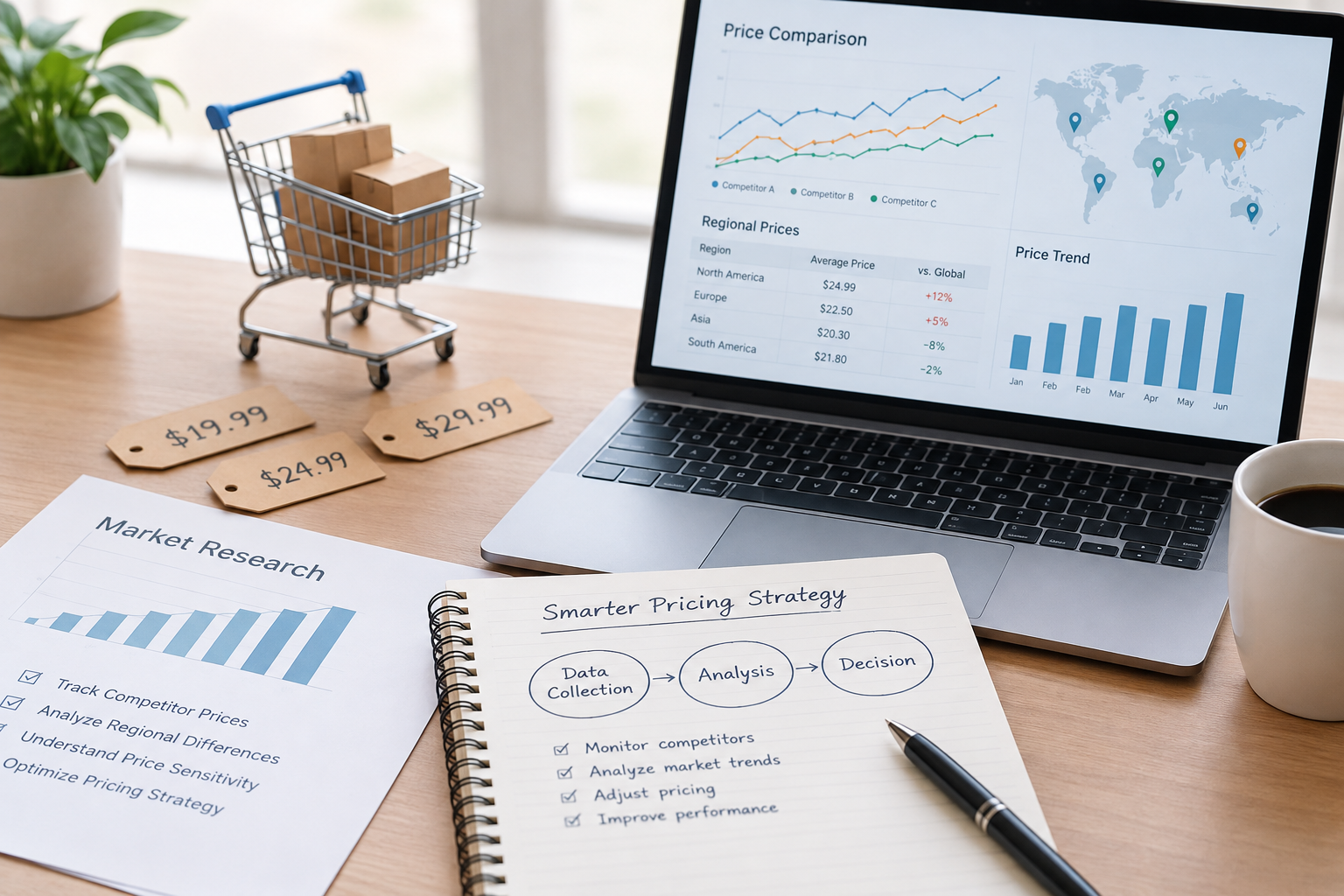
Price Sensitivity and Competitive Intelligence: How Businesses Can Optimize Pricing Strategies
Price sensitivity influences purchasing decisions, profit margins, and competitive positioning. By monitoring competitor prices, analyzing regional market differences, and combining external data with internal business metrics, companies can develop smarter pricing strategies. Proxy IPs and automated data collection tools can support cross-regional market research, helping businesses gather public pricing information and identify market trends more efficiently.

In today's increasingly competitive digital economy, pricing is no longer simply a matter of assigning a number to a product. For industries such as e-commerce, retail, travel, and digital services, pricing directly influences consumer purchasing decisions, profit margins, and a brand's competitive position.
As online sales channels continue to expand, consumers can compare product prices, promotional offers, and service conditions across multiple platforms within minutes. This greater transparency has intensified market competition and created new challenges for businesses. How can companies maintain profitability while meeting customer price expectations? How can they determine whether a competitor's price changes require a response? And how can they use market data to identify the factors that influence sales performance?
Addressing these questions requires businesses to understand price sensitivity, establish a systematic competitive intelligence process, and transform market data into actionable pricing strategies.
1. What Is Price Sensitivity, and Why Does It Matter?
Price sensitivity refers to the degree to which consumers respond to changes in the price of a product or service. In practical terms, it measures how price increases or decreases influence purchasing intentions, purchase volumes, and brand preferences.
Price sensitivity is not a fixed characteristic. Even for the same product, different customer segments, market conditions, and purchasing scenarios can produce significantly different responses to price changes.
For example, consumers purchasing everyday essentials may prioritize price comparisons across retailers. However, when buying professional software, enterprise services, or high-value equipment, they may place greater importance on reliability, functionality, customer support, and long-term ownership costs.
From a business perspective, customers can generally be grouped into three categories:
- Highly price-sensitive customers: These customers respond strongly to price changes and may switch brands following a price increase. Discounts and promotional offers can also have a substantial influence on their purchasing decisions.
- Moderately price-sensitive customers: These customers consider price an important factor but also evaluate product quality, brand reputation, convenience, and service.
- Less price-sensitive customers: These customers prioritize value, reliability, specialized capabilities, or brand trust and may be less responsive to reasonable price adjustments.
Understanding these differences helps businesses avoid applying a single pricing strategy to every customer. For cost-conscious segments, flexible packages and clearly defined pricing tiers may be effective. For customers who prioritize service quality, reliability, technical capabilities, and consistent performance can help demonstrate value.
An effective pricing strategy is not necessarily about offering the lowest price. It is about finding the right balance between perceived customer value and business profitability.
2. What Factors Influence Business Pricing Decisions?
Pricing strategies are shaped by multiple factors. Looking only at competitors' prices is rarely enough to explain market changes or support long-term decisions.
2.1 Inflation and Cost Changes
Changes in raw material, logistics, labor, energy, and procurement costs can all affect profit margins. When operating costs rise, businesses must decide whether to adjust prices, improve operational efficiency, or redesign their product offerings.
However, rising costs do not automatically mean that businesses can pass every additional expense on to consumers. In highly price-sensitive markets, aggressive price increases may reduce conversion rates or encourage customers to consider alternatives.
Companies should therefore evaluate cost changes alongside customer demand and competitive conditions before deciding how much to increase prices and when to implement the changes.
2.2 Tariffs, Supply Chains, and Policy Changes
For cross-border e-commerce businesses, international traders, and global enterprises, tariffs, transportation costs, exchange-rate fluctuations, and regional policy changes can influence final selling prices.
The same product may have significantly different cost structures across countries. Businesses that rely on data from a single market when developing global pricing strategies may overlook differences in purchasing power, competitive conditions, and distribution costs.
A more effective approach is to analyze markets separately by region, monitor local price levels and promotional trends, and adjust pricing strategies according to regional conditions.
2.3 Competitor Pricing Behavior
Competitors' price adjustments can reveal important market signals, including promotional cycles, inventory pressure, changes in product positioning, and efforts to gain market share.
However, a competitor's price reduction does not necessarily mean that a business should lower its own prices. If competing products differ in functionality, service coverage, or target customers, matching their prices immediately may unnecessarily reduce profit margins.
Businesses should examine more than the final price. They should also consider when the change occurred, how long it lasted, what promotional conditions applied, and how the products compare in terms of value.
2.4 Consumer Demand and Market Expectations
Consumer demand changes with seasonality, economic conditions, product popularity, and purchasing habits. For example, travel products may experience significant price differences between peak and off-peak seasons, while electronics often see pricing fluctuations around new product launches and major promotional events.
By identifying these changes early, businesses can adjust inventory, promotional campaigns, and pricing plans before declining sales force them to react.
3. Why Is Competitor Price Monitoring Essential to Pricing Strategy?
Competitor price monitoring involves continuously collecting, organizing, and analyzing publicly available pricing information to understand market developments and support business decisions.
Compared with occasional manual checks, systematic price monitoring provides more comprehensive historical records and trend information. This allows businesses to move beyond one-time price comparisons and develop a longer-term understanding of market behavior.
3.1 Identify Market Pricing Trends
Continuous monitoring helps businesses understand price ranges, typical discount levels, and the frequency of price changes within a product category.
For example, an online retailer may notice that competitors have been reducing the prices of a popular product category for several consecutive weeks. By comparing historical data with other market indicators, the retailer can investigate whether the trend reflects a temporary promotion, a broader industry price decline, or a new competitive strategy.
This analysis helps businesses avoid making rushed pricing decisions in response to isolated changes.
3.2 Identify Regional Market Differences
In cross-border e-commerce and international business, the same product may be priced differently across regions because of currency differences, logistics costs, promotions, and local competition.
Collecting publicly available information from multiple target markets helps businesses identify regional price gaps, understand the options available to local consumers, and improve market-entry strategies.
However, observed price differences do not necessarily indicate differences in consumers' willingness to pay. Taxes, shipping fees, product specifications, coupons, and membership discounts must also be considered to ensure meaningful comparisons.
3.3 Respond to Competitive Changes More Quickly
The value of market intelligence depends not only on accuracy but also on how quickly the information can be collected and processed.
Businesses that manually check prices once a week may miss short-term promotions, price reversals, or rapid competitor adjustments. Automated data collection can reduce repetitive work and help teams identify unusual changes more promptly.
Nevertheless, automation does not mean that every price change should trigger an immediate business response. Companies still need appropriate monitoring intervals, change thresholds, and review procedures to avoid reacting to temporary fluctuations, inaccurate records, or irrelevant promotional information.
4. How Proxy IPs Support Cross-Regional Price Monitoring and Market Research
For businesses operating across multiple countries and regions, pricing research requires more than analyzing sales figures. Companies also need to understand how products are priced, promoted, and presented in different markets.
Depending on location, currency settings, promotional policies, and product availability, the same item may appear differently on public webpages across regions. If a business accesses a target website from only one location, the information collected may not fully reflect conditions in other markets.
4.1 Access Public Market Information Across Different Regions
During cross-regional market research, businesses can select proxy IPs associated with relevant geographic locations to access public product pages under appropriate connection conditions. This can help researchers collect information about prices, discounts, and product availability across different markets.
For example, an e-commerce company planning to expand into Europe and Southeast Asia may monitor public product pages across these regions. By comparing prices, promotional frequency, and product availability, the company can gain insights to support market-entry planning and pricing decisions.
Proxy IPs provide geographic flexibility for this process, allowing research teams to configure connections according to their target markets.
4.2 Support Scalable Public Data Collection
When businesses need to monitor hundreds or even thousands of product pages, manually browsing websites and recording prices becomes time-consuming and difficult to maintain consistently.
Combining automated web data collection tools with appropriate proxy IP configurations can help businesses establish a more systematic market intelligence workflow. Data collection tasks can run according to predefined rules, with the results organized into structured datasets for analyzing price changes and competitive trends.
However, proxy IPs are only one component of the data collection process. Efficiency and success rates also depend on website access rules, request frequency, page structure, and the configuration of the collection tools.
4.3 Choose Proxy IP Resources That Match Business Requirements
For companies conducting cross-regional pricing research, competitor monitoring, and public webpage data collection, factors such as geographic location, proxy type, and connection configuration may influence the overall workflow.
IPdunar provides a range of proxy IP resources for businesses and developers, allowing users to select suitable proxy types and geographic locations according to their operational needs. By incorporating proxy IPs into public market data collection workflows, teams can configure regional connections more flexibly and support cross-market price comparisons.
When choosing proxy IP resources, businesses should evaluate their target websites, collection scale, geographic requirements, and project budgets rather than focusing on a single metric. They should also comply with applicable laws, website terms, and relevant privacy requirements when collecting public data.
5. How to Use Data to Develop Smarter Pricing Strategies
An effective pricing process connects data collection, analysis, decision-making, and performance evaluation. The following steps can help businesses establish a more structured approach.
Step 1: Define Business Objectives and Monitoring Scope
Before collecting data, businesses should identify the questions they want to answer.
Common objectives include:
- Understanding the price ranges of major competitors.
- Monitoring promotional offers and discount changes for key products.
- Identifying price differences across countries and regions.
- Analyzing the relationship between pricing changes and sales performance.
- Evaluating the competitiveness of products in target markets.
Businesses can then determine which products, competitors, regions, and monitoring intervals are most relevant.
There is no need to monitor the entire market from the beginning. Prioritizing high-volume products, high-margin items, or categories with intense competition often makes it easier to achieve measurable results.
Step 2: Establish a Reliable Data Collection Process
Data quality determines the usefulness of subsequent analysis. Collected information should be accurate, consistent, and suitable for comparison across different time periods.
Common sources include public product pages, retail platforms, brand websites, promotional pages, and compliant data services.
For smaller operations, manual checks and spreadsheets may be sufficient. However, as the number of products, competitors, and target markets grows, manual collection can become inefficient, inconsistent, and difficult to update promptly.
Businesses can address these challenges by using web scraping tools, automated monitoring platforms, or customized data processing workflows to collect publicly available information.
For projects that require data collection across multiple regions, proxy IPs can help configure connections according to geographic requirements. Combined with suitable collection tools, data processing methods, and monitoring rules, they can support a more organized approach to gathering information from different markets.
Step 3: Clean Data and Ensure Meaningful Price Comparisons
Information collected from different websites cannot always be compared directly.
For example, two retailers may offer products from the same brand but with different specifications. One listed price may include shipping, while another may exclude additional charges at checkout. Some pages may display member-only prices rather than offers available to ordinary customers.
Ignoring these differences can lead to misleading conclusions.
Businesses should establish standardized data fields, such as:
Data Field | Analytical Purpose |
|---|---|
Product name and specifications | Confirm that compared products are equivalent |
Current listed price | Track market price levels |
Currency and target region | Enable cross-regional comparisons |
Promotional terms and discounts | Distinguish regular prices from promotional offers |
Collection timestamp | Identify when and how frequently prices change |
Product availability | Avoid comparing out-of-stock items with available products without context |
After standardization, businesses can analyze price gaps, promotional patterns, and market trends more reliably.
Step 4: Analyze Price Changes Alongside Business Metrics
Competitor prices alone cannot fully explain a company's sales performance. External market data should be evaluated alongside internal business metrics.
Relevant indicators include:
- Conversion rate: Whether the proportion of visitors who make purchases changes after a price adjustment.
- Gross margin: How discounts or price reductions affect profit per transaction.
- Sales volume: Whether a pricing change leads to more orders.
- Customer acquisition cost: Whether the cost of attracting new customers changes.
- Customer retention: Whether pricing adjustments affect repeat purchases.
Suppose an e-commerce business discovers that a major competitor has reduced the price of a product by 8%. Rather than immediately matching the reduction, the business should first examine its own margins, conversion rates, customer feedback, and competitive advantages.
If the product offers clear service or quality advantages, maintaining the current price while communicating its value more effectively may be the better choice. If the products are highly similar and competitive pressure is affecting conversion rates, a limited-time promotion or targeted discount may be more appropriate.
Ultimately, pricing decisions should be based on multiple indicators rather than a single price signal.
Step 5: Test Strategies and Continuously Improve
Even thorough data analysis cannot guarantee that every pricing adjustment will produce the expected results.
Businesses can use small-scale tests, phased implementation, or compliant experiments involving different customer segments to evaluate how alternative pricing strategies affect conversion rates, revenue, and profitability.
During testing, companies should control other variables where possible, including advertising expenditure, inventory levels, page design, and promotional campaigns. Otherwise, changes in sales performance may be difficult to attribute to a specific pricing adjustment.
As more results become available, businesses can refine price ranges, promotional schedules, and product offerings to create a continuously improving pricing process.
6. How Automated Data Collection Improves Competitive Intelligence
For businesses monitoring large numbers of products across multiple markets, automated data collection can transform fragmented market observations into a more consistent and repeatable workflow.
6.1 Reduce Manual Work
Manual checks are suitable for small-scale research. However, when monitoring hundreds or thousands of products, visiting each webpage and recording prices can consume substantial time.
Automated collection tools can gather information, update records, and generate structured outputs according to predefined rules. This allows teams to spend more time analyzing results and making business decisions.
6.2 Improve Visibility Into Market Changes
Regular collection creates historical datasets that help businesses distinguish temporary price fluctuations from sustained trends.
By comparing information across multiple time points, teams can examine competitor pricing before and after promotions, identify seasonal patterns, and evaluate whether price competition is becoming more intense in a particular market.
Monitoring frequency should still reflect actual business requirements. Excessively frequent requests can increase operating costs and may conflict with target websites' usage policies.
6.3 Support Cross-Regional Market Research
Public webpages may display different content depending on location, language settings, currency, inventory, and local promotions.
For international businesses, appropriately configured access from target regions can help researchers better understand how public pages are presented in those markets.
Proxy IPs can help configure connections for specific geographic locations within this workflow. However, they cannot guarantee that the resulting pages will exactly match the experience of local consumers. Factors such as login status, cookies, language, device type, account permissions, and other settings may also affect what users see.
7. Common Challenges in Competitor Price Monitoring
Building a reliable price monitoring system requires more than increasing collection frequency. Businesses must also address several practical challenges.
Data accuracy. Listed prices may include promotions, membership discounts, or temporary adjustments. Businesses should retain collection timestamps and pricing conditions to avoid comparing fundamentally different offers.
Market coverage. Monitoring only a small number of competitors may provide an incomplete picture of the market. Monitoring lists should be reviewed regularly according to product categories and business objectives.
Collection reliability. Website structures, access rules, and page-loading methods may change, causing automated tasks to fail. Data workflows should include error logging, anomaly alerts, and periodic validation.
Operating costs. Collection tools, proxy resources, development, maintenance, and data storage all involve costs. Businesses should evaluate these investments based on the commercial value of the information rather than expanding collection without a clear purpose.
Compliance and data usage. Companies should prioritize information that is publicly available and permitted to access, comply with applicable laws and website terms, and avoid collecting unnecessary personal information.
By addressing data quality, operational efficiency, and compliance together, businesses can turn price monitoring into a dependable long-term capability.
Conclusion: Turn Price Sensitivity Into a Competitive Advantage
In digital markets, consumers can compare prices more easily, and competitors can adjust their strategies more quickly. Businesses therefore need more than a competitive price. They need a systematic way to understand market conditions, identify changes, and evaluate the outcomes of their decisions.
Price sensitivity helps businesses understand how customers respond to pricing. Competitor price monitoring reveals what is happening in the market. Data analysis transforms these insights into actionable business decisions.
By establishing standardized data collection processes, combining external market intelligence with internal performance metrics, and continuously testing and refining pricing strategies, businesses can make more informed decisions that balance customer expectations, competitive positioning, and profitability.
For teams conducting cross-regional market research, suitable data collection tools and proxy IP resources can also support the overall workflow. IPdunar provides a range of proxy IP options that businesses and developers can configure according to geographic and operational requirements, supporting cross-regional price monitoring and public market data collection.
Ultimately, an effective pricing strategy does not mean always offering the lowest price. It means delivering competitive value to the right customers in the right markets at the right time, with data guiding every adjustment.