Free Proxies vs. Paid Proxies: Which Is the Better Choice for Your Online Activities?
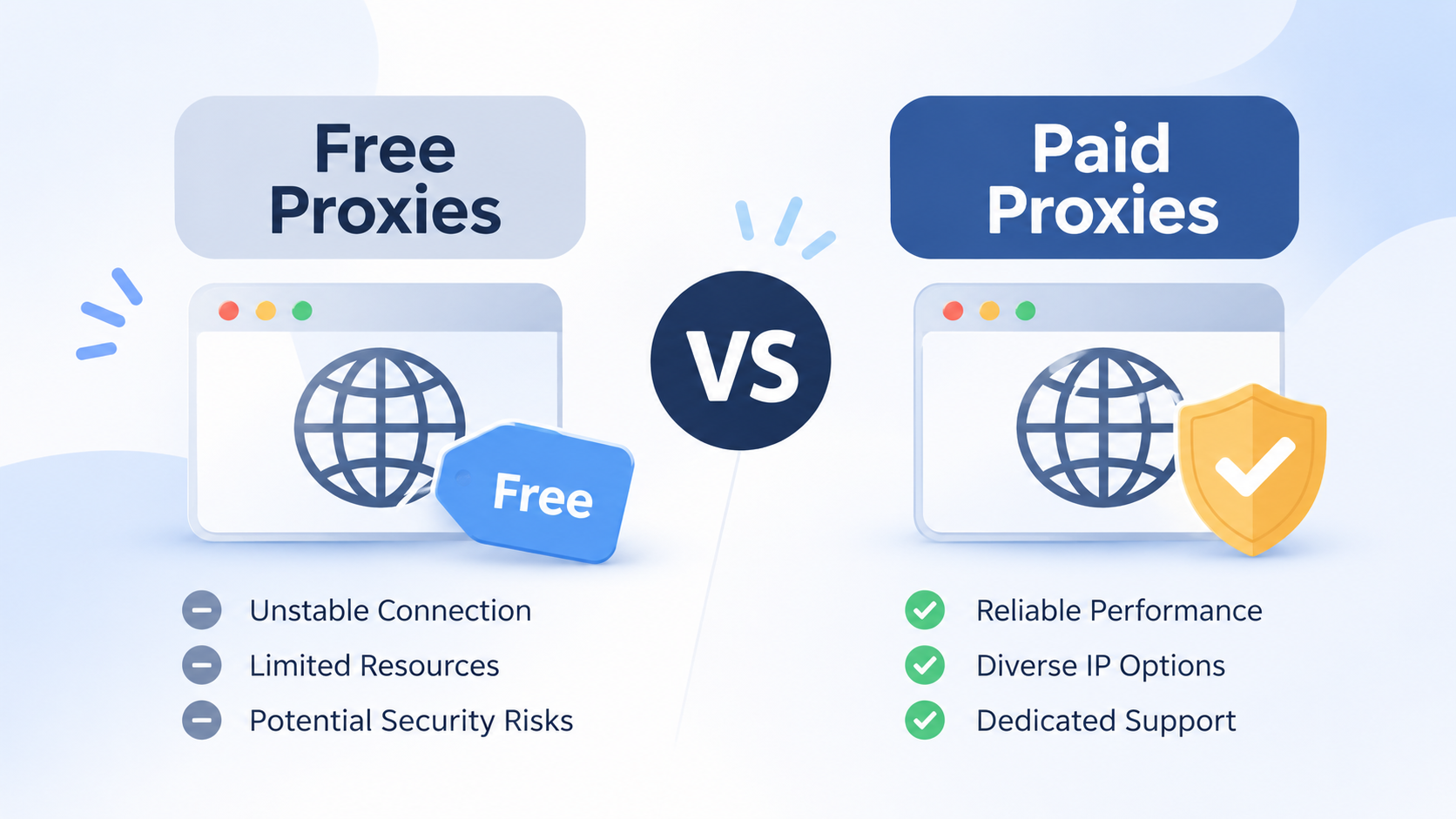
Free proxies are convenient and cost nothing, but they often come with unstable connections, limited resources, and potential security risks. Paid proxies offer more reliable performance, flexible IP options, broader geographic coverage, and better support for business activities such as web scraping, SEO monitoring, and market research. The best choice depends on your usage needs, performance expectations, and budget.

As online businesses continue to expand globally, proxy services have become an important part of many digital workflows. From market research and web data collection to SEO monitoring and regional website testing, proxies help users access online resources through different IP addresses and network locations.
When looking for a proxy service, users often face a common question: Should they use free proxies or invest in a paid proxy solution?
At first glance, free proxies may seem like the more attractive option because they do not require an upfront payment. However, the actual value of a proxy service involves much more than its initial cost. Factors such as connection stability, IP quality, geographic coverage, privacy, and resource availability can all affect the overall experience.
In this article, we will explore the differences between free and paid proxies, examine their advantages and limitations, and explain how to choose the right solution for your needs.
1. Understanding Free Proxies and Paid Proxies
Before comparing the two options, it is important to understand how free and paid proxy services work.
What Are Free Proxies?
Free proxies are proxy servers that users can access without paying a service fee. They are commonly found on public proxy websites, online proxy lists, or platforms that provide limited free access.
These proxies allow users to route their internet traffic through an alternative IP address without purchasing a subscription. Depending on the provider, they may support different connection protocols and locations.
The biggest advantage of free proxies is accessibility. Users can quickly obtain a proxy and test whether a particular connection or regional access environment meets their basic requirements.
However, free proxy resources can vary significantly in quality. Some nodes may be unstable, overloaded, or no longer available. In addition, information about IP sources, server maintenance, and data-handling practices may be limited.
As a result, free proxies are generally more appropriate for occasional, non-sensitive activities rather than workflows that depend on consistent performance.
What Are Paid Proxies?
Paid proxies are services provided by commercial proxy providers. Users pay for access to proxy IP resources according to a specific pricing model, such as traffic consumption, IP quantity, bandwidth, or subscription duration.
Unlike many publicly available proxy resources, professional proxy services typically offer clearer product specifications and usage policies. Depending on the provider and product, users may also have access to geographic targeting, different proxy types, authentication methods, and technical support.
Paid proxies are commonly used in business environments where connection quality, resource availability, and predictable usage costs are important.
Nevertheless, paying for a proxy does not automatically guarantee excellent performance. Different providers offer different resource quality and service standards. Users should evaluate a provider based on actual testing and their own requirements.
2. Free Proxies vs. Paid Proxies: A Detailed Comparison
Although both free and paid proxies serve the same basic purpose of routing network traffic through proxy servers, their service models and practical performance can be quite different.
Here are some important factors to consider:
Comparison Factor | Free Proxies | Paid Proxies |
|---|---|---|
Initial Cost | Usually free | Requires payment |
Connection Stability | Often unpredictable | Depends on provider and product quality |
Connection Speed | May fluctuate significantly | More options for performance requirements |
IP Availability | Public resources may disappear | Usually more clearly defined resources |
Geographic Coverage | Often limited | May support multiple countries and cities |
IP Selection | Limited filtering options | May offer residential, ISP, and datacenter options |
Traffic Management | Restrictions may be unclear | Usually defined by the purchased plan |
Technical Support | Often unavailable | May be available depending on the provider |
Long-Term Usage | Less predictable | More suitable when resources are properly managed |
Business Applications | Basic testing and occasional access | Ongoing data collection and business workflows |
The most important distinction is not simply whether a proxy costs money. It is whether the available resources can consistently meet the requirements of the intended task.
3. The Advantages and Limitations of Free Proxies
Free proxies can be useful in certain situations, especially when users want to experiment with proxy connections without committing to a paid service.
However, their limitations should be carefully considered.
3.1 No Direct Service Cost
The most obvious advantage of free proxies is that users do not need to purchase a subscription or traffic package.
For individuals who only need to perform a quick connection test or access a non-sensitive public webpage, free resources may be sufficient.
They can also help beginners understand how proxy connections work before selecting a more suitable service.
3.2 Easy to Access
Many free proxy lists are publicly available online. Users can browse available IP addresses and try connecting without going through a lengthy purchasing process.
This makes free proxies convenient for simple experiments and temporary use.
3.3 Unstable Connections
One of the main disadvantages of free proxies is inconsistent connection quality.
Public proxy servers may be shared by numerous users at the same time. Heavy traffic can result in congestion, connection timeouts, and fluctuating response times.
Some nodes may also become unavailable without warning. If a workflow depends on maintaining a stable connection, these interruptions can reduce efficiency.
3.4 Uncertain IP Quality
Free proxy services do not always provide sufficient information about their IP resources.
Users may have difficulty determining the IP's origin, network type, previous usage history, or current availability.
For tasks that require specific geographic locations or particular IP characteristics, this lack of transparency can create additional challenges.
3.5 Potential Privacy and Security Concerns
A proxy server sits between the user and the destination website. Therefore, the provider's security practices and trustworthiness matter.
Some unverified public proxy services may collect connection information, monitor traffic, or interfere with unencrypted communications.
Users should avoid transmitting passwords, payment information, or other sensitive data through proxy services whose security and privacy practices have not been verified.
3.6 Limited Support and Maintenance
Free proxy resources often come without dedicated technical support.
When a connection stops working, users may have to search for another IP address or troubleshoot the problem themselves. This can become inconvenient when proxy access is part of a regular workflow.
Overall, free proxies are useful for basic experimentation, but their limitations make them less predictable for important or continuous tasks.
4. Why Do Businesses Choose Paid Proxy Services?
For businesses that depend on online data, proxy performance can directly influence operational efficiency.
A proxy connection that frequently fails may interrupt data collection, delay analysis, and increase the time required to complete a task.
Paid proxies can offer a more structured solution for businesses with specific network requirements.
4.1 More Predictable Resource Availability
Professional proxy providers generally offer defined products and resource specifications.
Depending on the service, users may be able to select specific IP types, locations, traffic packages, or connection options.
This makes it easier to build a proxy environment that matches the requirements of a particular project.
4.2 Better Options for Geographic Targeting
Businesses operating across multiple markets often need to view websites and online content from different geographic locations.
For example, an e-commerce company may need to compare product prices in the United States, Japan, Germany, and other markets.
Paid proxy services may offer broader geographic coverage and more flexible location selection, helping businesses conduct regional research and access localized content.
4.3 Suitable for Ongoing Data Collection
Many business workflows require repeated access to public online information.
Examples include:
- Competitor price monitoring
- Product catalog collection
- Market trend analysis
- Search engine results monitoring
- Public website data research
- Regional content verification
For these activities, connection consistency and resource management can be more important than simply obtaining an IP address at no cost.
Paid proxy services may provide more suitable resource options for long-running workflows, depending on the provider's infrastructure and service terms.
4.4 More Flexible Proxy Types
Different online tasks may require different types of IP resources.
Professional providers may offer several proxy categories, including:
Residential Proxies
Residential proxies use IP addresses associated with residential networks. Dynamic residential proxies are often selected for tasks that require IP rotation, geographic flexibility, and access through residential network environments.
Static ISP Proxies
Static ISP proxies combine ISP-associated network infrastructure with IP addresses designed for longer-term use. They can be useful for workflows that benefit from maintaining a relatively consistent IP address.
Datacenter Proxies
Datacenter proxies use IP resources hosted in data centers. They are often considered when users prioritize connection speed, cost efficiency, and predictable network infrastructure.
Unlimited Proxy Solutions
Some providers offer plans designed around continuous or high-volume traffic requirements. Depending on the plan, these solutions may be priced by bandwidth, ports, or subscription duration.
Having access to different proxy types allows businesses to select resources according to their technical requirements instead of relying on a single proxy configuration.
4.5 Access to Technical Assistance
A professional proxy provider may offer setup guidance, connection documentation, troubleshooting assistance, and customer support.
This can be particularly useful for businesses integrating proxies into automated workflows, internal tools, or data collection systems.
However, support availability and response standards vary between providers, so it is important to review the actual service terms before purchasing.
5. Common Use Cases: When Is a Paid Proxy Worth the Investment?
Not every user needs a paid proxy. The right choice depends on the frequency, complexity, and importance of the task.
Here are several scenarios where paid proxy services may provide additional value.
5.1 E-commerce and Competitor Price Monitoring
Online retailers frequently monitor competitors' product prices, promotions, inventory information, and product availability.
When researching multiple markets, businesses may need to access websites from different geographic locations.
Residential and ISP proxies can help establish regional access environments for these research activities.
A suitable proxy solution can make recurring data collection easier to manage and help businesses obtain information for pricing decisions.
5.2 Web Scraping and Data Collection
Web scraping is commonly used to collect publicly accessible information for research, analysis, and business intelligence.
However, large-scale data collection can involve substantial numbers of requests and different geographic requirements.
A proxy service with suitable IP resources, location options, and traffic capacity may help businesses manage these workflows more effectively.
Users should always respect website terms, applicable laws, privacy requirements, and access restrictions when collecting data.
5.3 SEO and Search Engine Monitoring
Search results can differ depending on the user's geographic location and search environment.
SEO professionals may use proxies to inspect localized search results, monitor keyword rankings, and evaluate how websites appear in different markets.
Paid proxies with geographic targeting options can make these checks more flexible.
5.4 Website and Application Testing
Businesses that operate websites or online applications internationally need to understand how their services perform across different network environments.
Proxies can help testing teams simulate connections from selected regions and check regional accessibility, page loading, and application connectivity.
For recurring testing projects, stable and clearly documented proxy resources can simplify the testing process.
5.5 Market Research and Business Intelligence
Companies often collect publicly available information to understand industry trends, product positioning, customer preferences, and competitor activity.
When research involves multiple regions or repeated data collection, paid proxy services may provide more suitable resource options than unpredictable public proxy lists.
6. How to Choose the Right Paid Proxy Provider
Choosing a proxy provider requires more than comparing the advertised price per IP or gigabyte.
A low-cost service may not be the most economical option if its performance does not meet your requirements. Similarly, a premium-priced service is not necessarily the best choice for every project.
Consider the following factors before making a decision.
6.1 Identify the Proxy Type You Need
Start by understanding your actual use case.
Do you need rotating residential IPs, relatively consistent ISP IPs, or datacenter resources?
Each proxy type has different characteristics and pricing structures. Selecting the right category can help avoid unnecessary costs.
6.2 Check Geographic Coverage
If your business operates across multiple markets, geographic availability is an important consideration.
Check whether the provider supports your target countries and, if necessary, specific cities or regions.
Do not assume that a provider supports every location simply because it advertises global coverage.
6.3 Test Speed and Connection Stability
Before purchasing a large package, test the proxy under conditions similar to your actual workflow.
Useful metrics include:
- Connection success rate
- Average response time
- Latency
- Download and upload speed
- Performance during continuous connections
A short test can help identify whether the service is suitable for your application.
6.4 Review Traffic and Bandwidth Policies
Different proxy products may use different pricing models.
Some residential proxy services charge according to traffic consumption, while static IP products may be priced per IP. Unlimited solutions may have their own bandwidth, port, concurrency, or usage conditions.
Make sure you understand what is included in the package and whether any restrictions apply.
6.5 Evaluate Privacy and Service Transparency
Review the provider's privacy policy, data-handling practices, acceptable-use policy, and IP resource information.
A reliable provider should make its service terms reasonably clear so that customers can understand how the proxy resources are managed.
6.6 Compare Total Cost Rather Than Advertised Price Alone
When comparing providers, consider the complete cost of using the service.
For example, a residential proxy priced by GB may be suitable for traffic-based workloads, while a static ISP proxy charged per IP may be more practical for long-term connections.
The best pricing model depends on actual consumption, required locations, connection duration, and project scale.
7. Free Proxies or Paid Proxies: Which One Should You Choose?
There is no universal answer. Both options have their own advantages, and the best choice depends on what you want to accomplish.
Choose free proxies if:
- You only need occasional access for basic testing.
- Your tasks do not involve sensitive information.
- You can tolerate occasional connection failures.
- You do not require specific IP locations or guaranteed resource availability.
Consider paid proxies if:
- You need proxy access for regular business activities.
- Your workflow requires specific countries or regions.
- You conduct recurring web data collection or market research.
- You need clearer traffic policies and product specifications.
- Connection stability and technical support are important to your operations.
For users who are still evaluating different providers, starting with a small trial is a practical way to compare actual performance before committing to a larger purchase.
Conclusion
Free proxies and paid proxies serve different purposes. Free proxies offer an accessible way to experiment with proxy connections, but their resource quality, availability, and privacy practices may be difficult to verify.
Paid proxy services, on the other hand, can provide more clearly defined IP resources, flexible product options, and service policies that are better aligned with ongoing business requirements.
For occasional, non-sensitive activities, free proxies may be sufficient. However, businesses involved in e-commerce research, SEO monitoring, web scraping, and cross-regional data collection may benefit from evaluating professional proxy solutions.
Ultimately, the right proxy is not necessarily the cheapest one. It is the one that offers an appropriate balance of performance, resource quality, geographic coverage, and overall cost.
Before making a purchase, identify your requirements, test the connection, review the provider's policies, and choose a solution that can support your workflow reliably.
Disclaimer: Proxy services should only be used for lawful and authorized purposes. Users are responsible for complying with applicable laws, privacy requirements, and the terms of service of the websites and platforms they access.